Roughly one in three calls I take starts with the same sentence: "We think we need to migrate." Sometimes it's Shopify Basic to Plus. Sometimes it's Magento to Shopify. Once, memorably, it was Shopify to Magento. The merchant has usually been thinking about the migration for months. Often they've already gotten quotes. The number is making them queasy.
I take these calls seriously. Migrations can be the right answer. But they almost never are, and the way I figure out which case I'm in is by working backwards from the symptom they actually came in with — not from the platform conversation they want to have.
The three real reasons people want to migrate
When you strip away the language, almost every migration request resolves to one of three underlying problems:
- The current site is slow, and the merchant believes the platform is the cause.
- The marketing team can't make changes without engineering, and the merchant believes the platform is the cause.
- An integration (subscription, B2B, ERP) is brittle, and the merchant believes the platform is the cause.
Notice the pattern. The platform almost never is the cause. The platform is what's visible when you don't know what to point at.
Before you replatform, your team should be able to point at exactly which 200ms is the bottleneck. If the data isn't there yet, the platform isn't the problem yet.
What a diagnostic actually looks like
Before I'll quote any rebuild or migration, I run a paid diagnostic — two to four hours of focused work, fixed fee. It is not a sales tool. It is a real piece of work, with a deliverable, and often enough it ends with me telling the merchant they don't need the project they came in for.
The diagnostic looks at three things, in order:
1. The actual numbers
Real Lighthouse runs across the top five page templates, on a throttled mobile connection. Real conversion-rate breakdowns by device, traffic source, and page type — not the rolled-up "store conversion" number. Real session recordings, watched by a human, of users who didn't convert.
This part is unglamorous and most of the merchants I've worked with had never done it. The Plus dashboard gives you headlines; it doesn't give you the diagnosis.
2. The theme audit
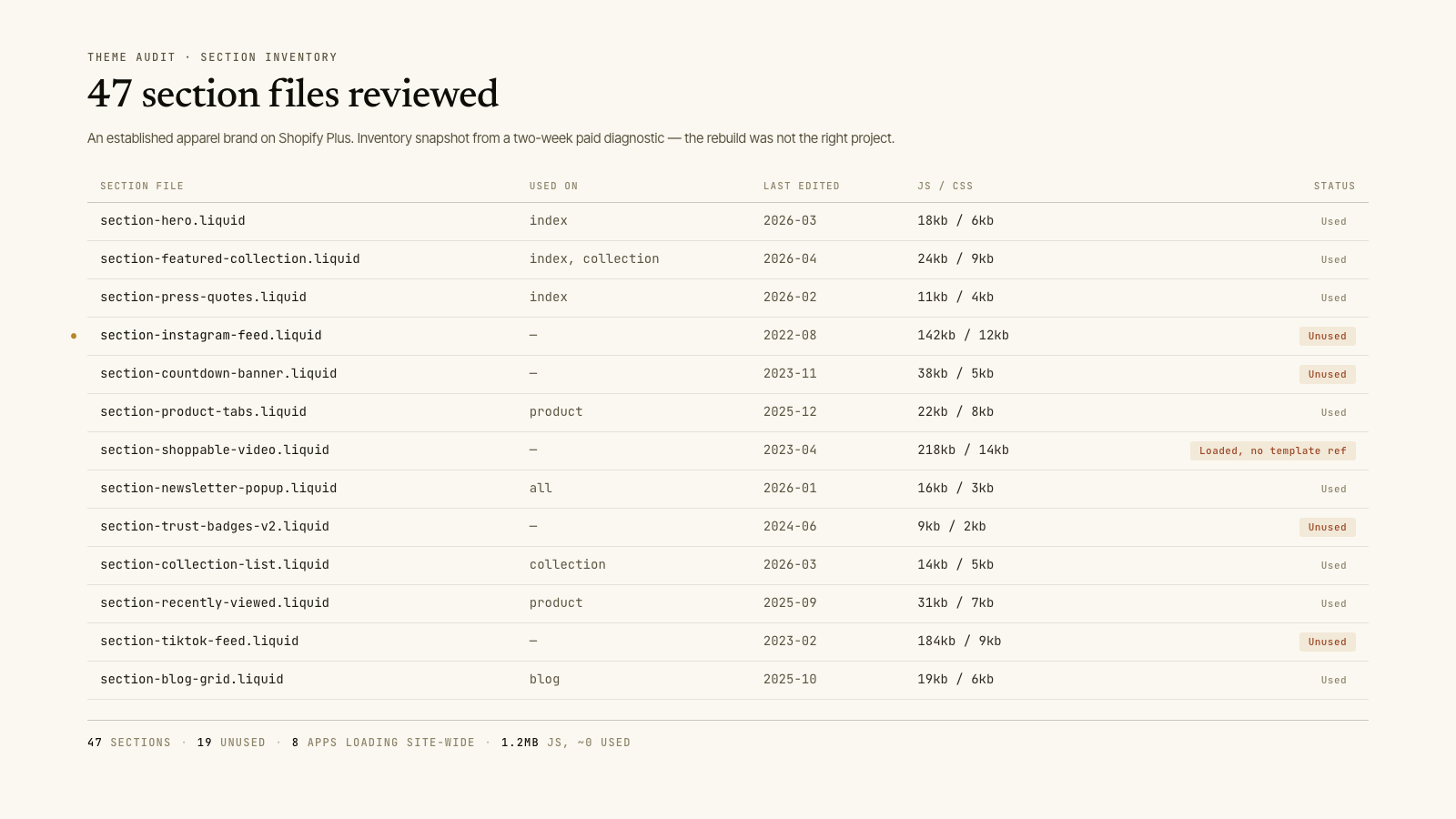
I read the theme. Not skim — read. config/settings_schema.json, every section file, the asset bundle, the third-party script tags. I make a list of what's there, what's used, and what's loaded but no longer wired up. The list is usually longer than anyone expects.
3. The team interview
The most important part. I talk to the marketing person who has to ship campaigns, the customer-service person who handles returns, and the founder who's signing the cheques. I ask each of them the same question: where do you wait the longest?
The answers rarely match the founder's theory. The founder thinks the problem is checkout. Marketing thinks it's the three-week banner queue. CS thinks it's the order-edit flow. They're all right, partially. The diagnostic exists to triangulate.
What the report actually says
At the end of it, I write the report. It contains, in order:
- The numbers, with a one-paragraph reading of what they mean.
- A ranked list of bottlenecks — usually 6 to 10 items.
- For each, an estimate of cost to fix and expected return.
- One bold recommendation at the top: do this, in this order.
And — this is the part most merchants are surprised by — more often than not, the recommendation is not "migrate." It's usually some combination of theme work, app removal, and a process change for the marketing team.
When migration is the answer
I don't want to leave the impression that I'm anti-migration. There are real cases where it's the right move. The clearest one: when the integration architecture has accumulated four or five custom apps and the merchant has lost the ability to make a change without breaking something else. Replatforming as a forcing function for simplification — that's legitimate.
But it's a small fraction of the cases that come in asking for it. And in the other cases, telling the merchant "you don't need this" is, frankly, the work I'm proudest of.
If you're weighing a migration or replatform right now and you're not certain it's the right move, that's worth a conversation before you commit the budget. Grab a slot and we can pressure-test whether you actually need it — or whether a smaller fix gets you there.